Digital Twin & Digital Thread
With the onset of the Fourth Industrial Revolution, or Industry 4.0/5.0, manufacturing companies have been exploring digital technologies from the aerospace and defense industry to transform their business models across the entire product lifecycle.
Many companies discuss digital twin and digital thread without differentiating them or investigating their evolution.
Origins of the Digital Twin
The history of digital twins can be traced to the early 90s when David Gelertner, a Yale University computer engineer, published his book Mirror Worlds: The Day Software Puts the Universe in a Shoebox (1991).
In his abstracted yet insightful prediction of the future digital world, Gelertner describes a world filled with “high-tech voodoo dolls,” where people are able to interact with reality by interacting with images.
Digital Twin in Manufacturing
When the concept of a digital twin was publically presented at the 2002 Society of Manufacturing Engineers conference by Michael Grieves, from the Florida Institute of Technology, it manifested the theoretical application of Gelertner’s Mirror Worlds within product lifecycle management (PLM).
In the context of the industrial application, Grieves defines the concept as the mapping of digital information to fully capture the “digital twin” of a physically manufactured product.
“At its optimum,” he explains, “any information that could be obtained from inspecting a physical manufactured product can be obtained from its digital twin” (2016).
In other words, the digital twin of a product not only captures realtime data but also allows users to interact with a digital model of a product in real-time — just like Gelertner’s Mirror Worlds.
However, digital twins are not limited to product development, as they can be extended to processes, systems, and even people. Since the early 2000s, the aerospace and defense industry has been pursuing avenues to apply this groundbreaking technology, and discrete manufacturers are now racing to transition to a digital environment as well.
What is Digital Thread?
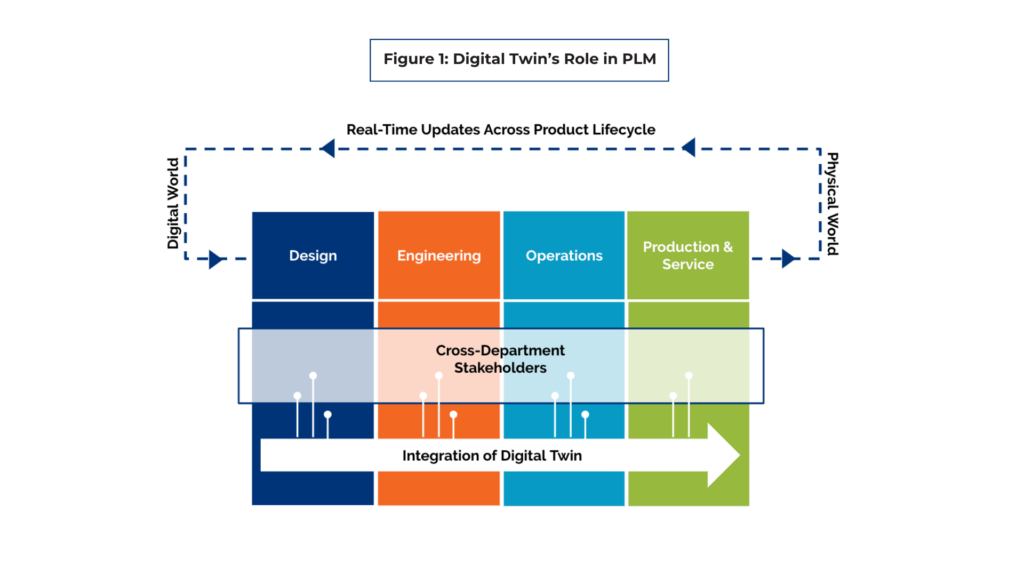
While the digital twin represents every facet of a physical product, the digital thread is the unified communication framework that facilitates integration across the product’s entire lifecycle from requirements to production.
This framework ultimately mitigates the inherent complexity of a digital twin by encouraging agile, data-driven decision-making among cross-departmental stakeholders (see Figure 1).
Start a dialogue with our team of qualified experts.
“Engineering service excellence is more than what we deliver; it is the foundation of who we are.”
Paul Hartman, Ph.D.
President
RGBSI A&D